
Review · TOKYO
Tokyo Sumo Experience: Chanko & Mochi with a Former Pro
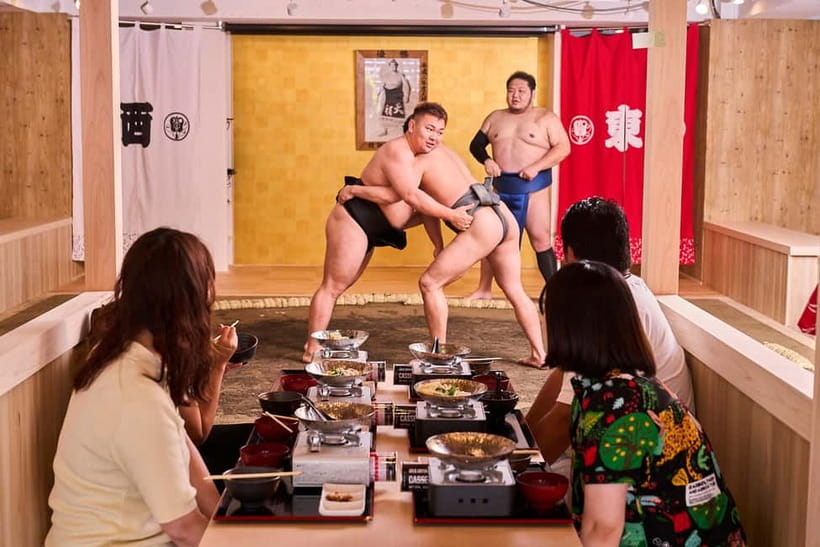
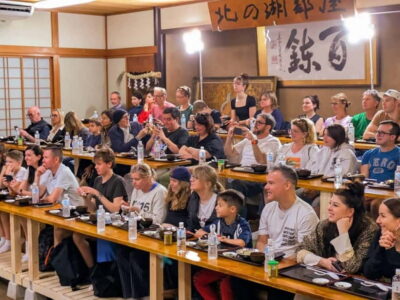
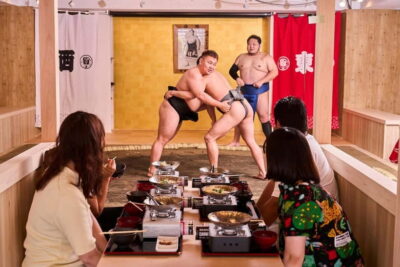
Sumo is usually watched from a distance. Here, you sit around the dohyo, eat the wrestlers’ traditional hot pot, and see the action close enough to appreciate the slap of feet and the force behind each push. The former professionals explain the sport, demonstrate techniques, and invite you onto the ring.
I especially like the mix of chanko nabe and mochi making. One gives you a taste of the wrestlers’ daily food, while the other turns a familiar Japanese sweet into a hands-on activity. The staff also make a real effort to involve children, teenagers, and adults.
The main thing to consider is that this is a lively entertainment show, not a quiet visit to a working stable or a serious morning training session. Seats are assigned by the venue, and the standard seating has special safety rules for children sitting on laps.
Key points at a glance
- Sumo in Ryogoku: The experience takes place a short walk from Ryogoku Station, in Tokyo’s main sumo district.
- Chanko nabe meal: Eat the hearty hot pot associated with sumo stables, with its flavor supervised by former wrestlers.
- Real participation: You can join mochi pounding, learn sumo techniques, and test your strength against a wrestler.
- Close-up demonstrations: Watch training movements and several rounds of sumo wrestling from seats around the dohyo.
- Good family format: The activities suit adults and children, although exact seating rules matter if you bring a young child.
- Two hours for $103: The price covers the meal, show, mochi activity, and wrestling participation, making it a full evening-style experience rather than a brief photo stop.
Why Ryogoku is the right place for sumo
Ryogoku is the natural setting for this activity. Tokyo has many polished cultural attractions, but this neighborhood is tied directly to sumo life. You can combine the experience with nearby sightseeing in Asakusa, Akihabara, Nihonbashi, or around Tokyo Skytree.
The venue is on the first floor and marked by a large sumo wrestler sign and flags. That helps, though one person found the location a little hard to spot, so I would arrive early rather than rush in at the last minute.
The short walk from Ryogoku Station is useful if you are building this into a busy Tokyo day. You do not need to devote an entire day to the activity. Two hours gives you a compact introduction to the sport, a meal, and several chances to take part.
More Sumo Experiences in Tokyo
- Tokyo: Sumo Show and Dining Experience
★ 4.8 · 2,742 reviews - the SUMO show
★ 5.0 · 1,960 reviews - Tokyo Shinjuku Sumo Show & Experience with Photo
★ 5.0 · 1,750 reviews
What happens when you take your seat
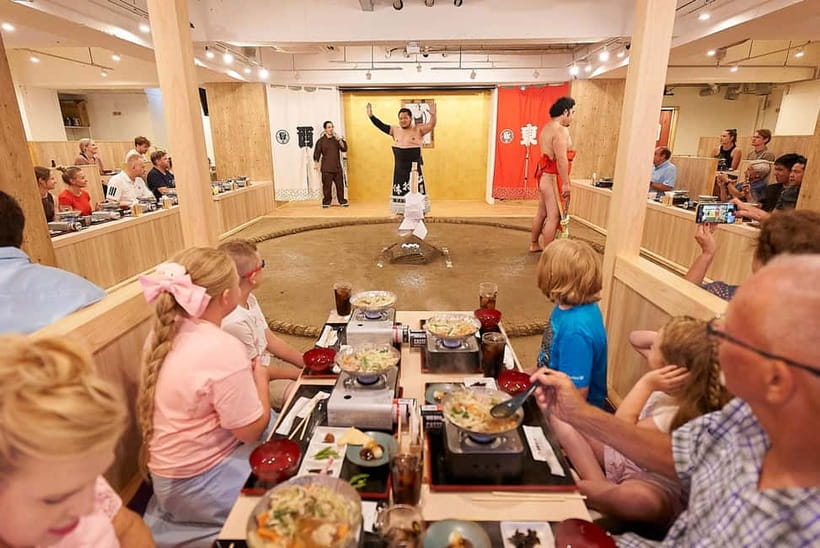
You sit around the dohyo, the raised ring where sumo matches take place. The assigned seating means you cannot choose a specific position, so do not book this expecting a front-row guarantee.
That said, the format puts the wrestlers close to the audience. The demonstration area is the focus of the room, and the experience is designed so you can watch techniques, training movements, and matches without needing prior knowledge of sumo.
An English and Japanese-speaking instructor helps explain what you are seeing. The tone is friendly and playful. You will learn about sumo training, techniques, diet, and the wrestlers’ way of life, but the presentation is kept moving with humor and audience participation.
This is helpful if you know little about sumo. Rather than watching a bout and trying to guess what happened, you get enough explanation to understand the basic movements and rituals. It also gives children something concrete to watch before they are invited to join in.
Chanko nabe brings the meal into the lesson
Chanko nabe is the meal most closely associated with sumo wrestlers. It is a hot pot dish served in many sumo stables, and here the flavor is supervised by sumo wrestlers from an actual stable.
The meal is more than a convenient dinner between activities. It explains part of how wrestlers fuel their demanding training. The dish is described as healthy, filling, and flavorful, with enough substance to count as a proper meal rather than a small tasting.
I like this part because it connects the show to everyday sumo life. You are not only watching a wrestler perform. You are eating a dish linked to the training culture you are learning about.
Food quality is one of the strongest parts of the experience. Several people found the meal better and more filling than expected, and families reported that even a six-year-old enjoyed it. A complimentary sour plum drink may also be served, but if you have an alcohol allergy, ask what is in the drink before accepting it.
Vegetarian, vegan, and gluten-free meals can be provided if requested at least two days before your reservation. Halal meals cannot be provided, although you may bring your own food. That last point is important, since the hot pot is part of the standard experience and substitutions are not available for every dietary need.
Mochi pounding is the most hands-on surprise
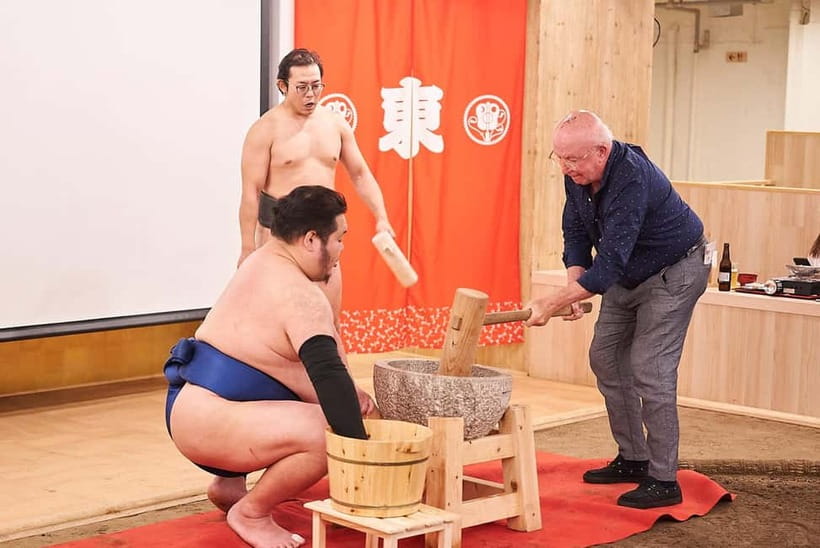
The mochi activity gives the program a nice change of pace. You watch a demonstration of the traditional pounding process, then get a chance to pound mochi with the wrestlers and eat sweet mochi afterward.
This is not just a dessert course placed at the end of a meal. The pounding demonstration shows how much rhythm and coordination go into making the sticky rice smooth and elastic. The wrestlers guide the activity, so you can take part without needing to know the technique beforehand.
For many people, this becomes the favorite activity. It is easy to understand, makes good photographs, and works for a wide range of ages. Parents can let children participate while still keeping the activity manageable and supervised.
You should bring a camera, but remember that the action moves quickly. The mochi pounding, wrestler demonstrations, and audience participation create several good photo opportunities. Comfortable clothes are also sensible, especially if you plan to step onto the dohyo.
Same city, another way to catch the action:
- Tokyo: Sumo Show and Experience in Shinjuku
★ 4.8 · 1,001 reviews - Tokyo Grand Sumo Tournament Viewing Tour with Tickets
★ 5.0 · 692 reviews - Tokyo Sumo Wrestling Tournament Experience
★ 5.0 · 660 reviews - Tokyo:Luxury Sumo Show Experience & Japanese cuisine & Drink
★ 4.7 · 577 reviews
The sumo demonstration gives you the real spectacle
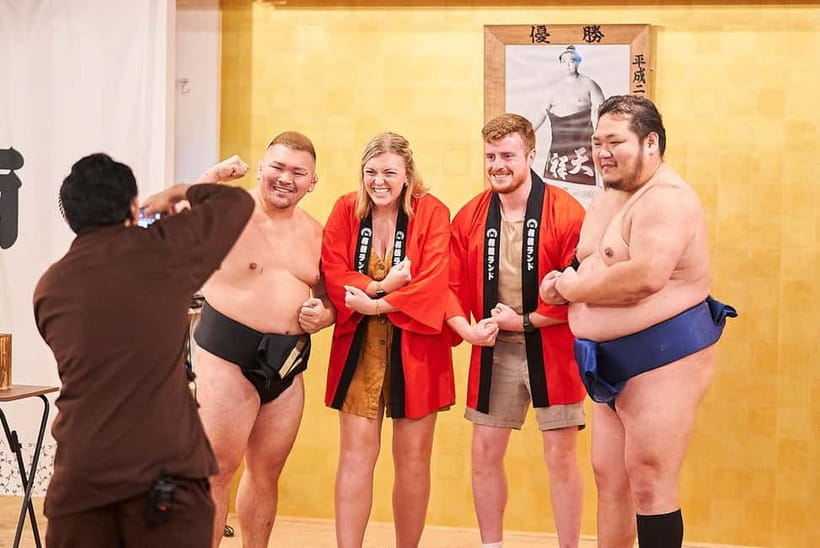
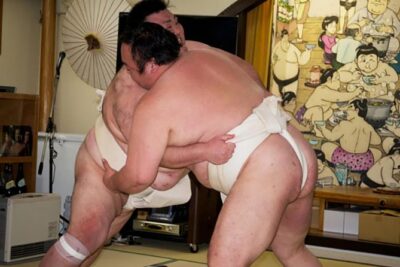
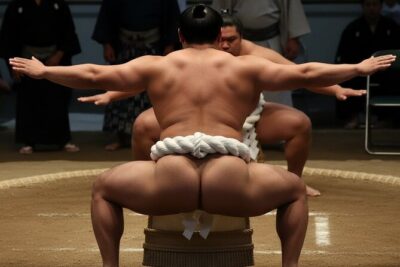
The wrestling demonstration is the dramatic center of the experience. You watch former professional wrestlers perform sumo at close range, including several rounds of wrestling and demonstrations of actual techniques.
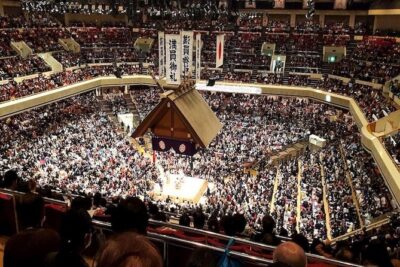
This is not the same as attending a grand sumo tournament. You are not watching a full day of official bouts, and the event is designed for explanation and entertainment. Still, seeing the wrestlers work only a short distance away gives you a useful sense of their size, balance, speed, and control.
The contrast between the playful hosting and the force of the demonstrations works well. One moment the room is laughing at audience participation. The next, the wrestlers are showing how quickly a match can turn through timing and footwork.
I would not book this expecting an unfiltered view of elite competition. Book it if you want an accessible introduction with demonstrations you can understand and enjoy. It is particularly useful if you are in Tokyo outside the main tournament periods, when seeing live sumo is harder.
Your turn on the dohyo
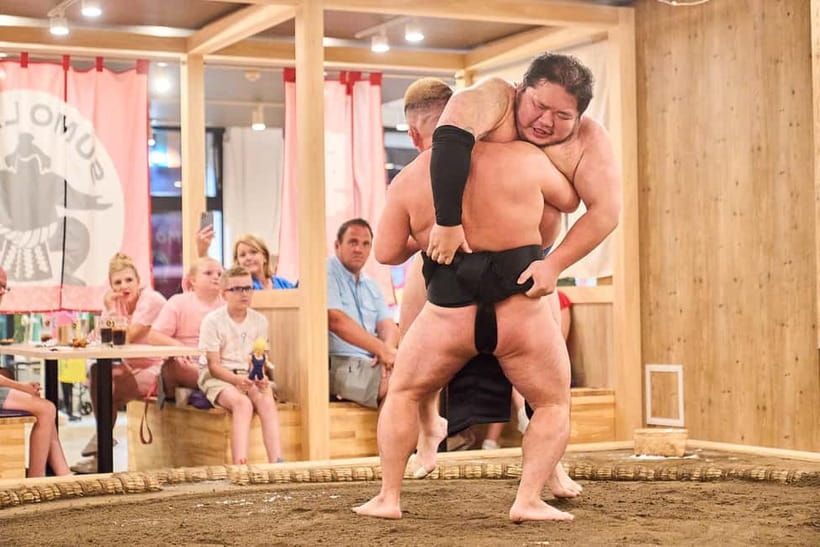
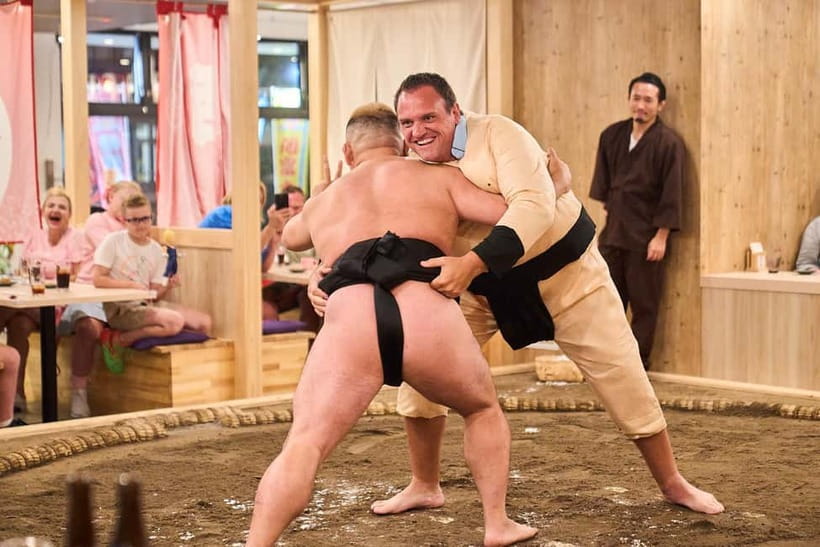
The most memorable part for many people is the chance to try sumo yourself. You may learn basic techniques, step onto the dohyo, and test your strength against a wrestler.
The invitation is open to children and adults, but participation is voluntary. You can remain seated and watch the demonstrations if you prefer. The experience is arranged so that joining in feels fun rather than intimidating, and the wrestlers encourage people to take part.
Do not mistake the activity for a real contest. The point is to feel the stance, the push, and the difficulty of moving someone who has trained in sumo. Even a strong adult quickly learns that balance and technique matter as much as raw force.
Wear comfortable clothing if you hope to participate. The activity includes movement and physical contact, so restrictive clothes are a poor choice. The supplied information does not list a specific minimum age or weight limit, so families with very young children should use their judgment.
The tone is friendly, but the format is not a training visit
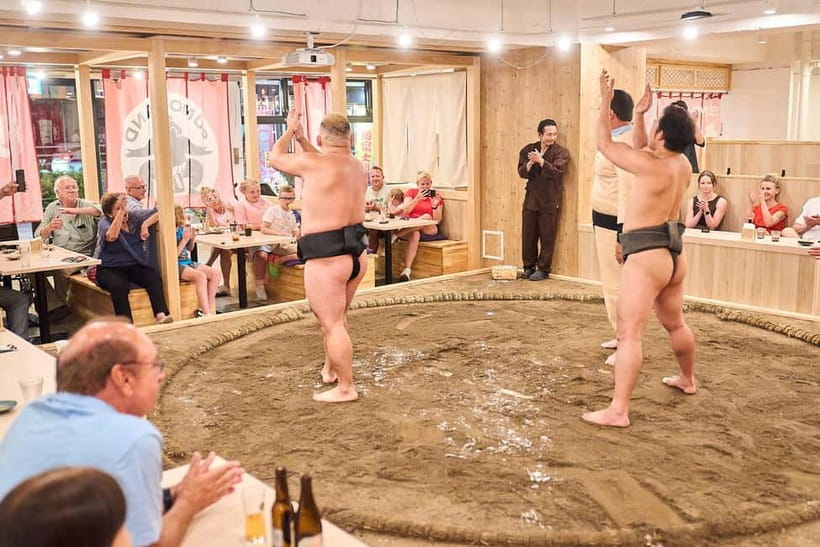
The hosts and wrestlers are central to the experience. They explain the activities, encourage audience participation, and keep the room moving. This personal interaction is why the experience works for groups who want more than a performance.
You will learn about sumo history, training, diet, and techniques, but the approach is light. It is built for adults and children, with plenty of laughter and chances to take photographs.
That also marks the main limitation. If your goal is to watch a silent, serious training session at dawn, this is not the right choice. The activity is intentionally entertaining and interactive. You will see real techniques and former professionals, but the schedule is shaped around audience enjoyment.
I see that as a strength for most first-time visitors. Sumo can seem formal and hard to follow when viewed only from the stands. Here, the explanations and activities give you a way into the sport.
Is $103 a fair price?
At $103 per person, this is not a bargain meal or a quick cultural demonstration. It is a two-hour package that combines a show, instruction, a substantial chanko nabe meal, mochi making, dessert, and the chance to wrestle with a former professional.
The value depends on what you would otherwise do. If you only want to see sumo, a museum or tournament ticket may suit you better. If you want dinner, entertainment, and active participation in one booking, the price is easier to justify.
I think the strongest value comes for families and small groups. The event gives different personalities something to do. One person can focus on food and photographs, another can learn about sumo, and the more adventurous members can step onto the dohyo.
The high overall rating of 4.8 from 567 reviews also fits the experience’s main strengths: food, friendly staff, clear explanations, and the number of activities packed into two hours. The praise is not based on one single trick. The program succeeds because the meal, demonstrations, and participation support each other.
Who should book this experience
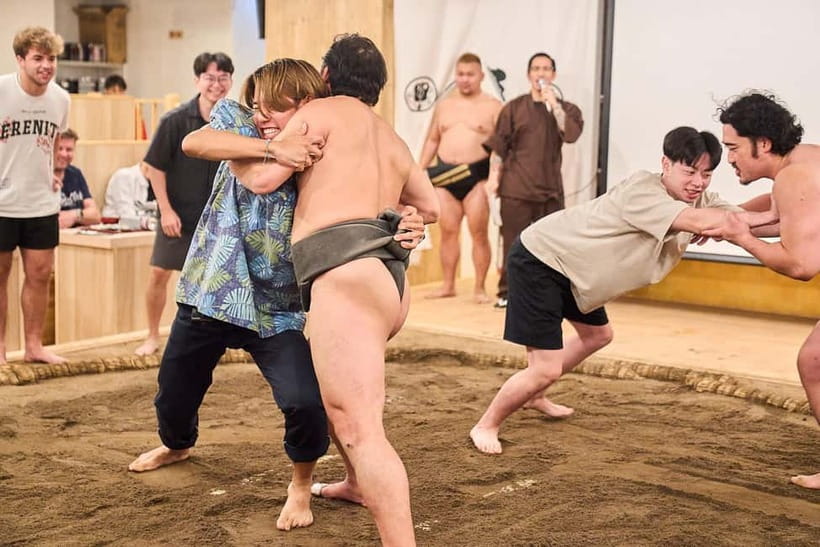
I would recommend it to:
- Families looking for a cultural activity that holds children’s attention
- First-time visitors who want an easy introduction to sumo
- Adults who enjoy food linked to local tradition
- Groups seeking a shared activity with plenty of photographs
- People visiting Tokyo outside an official sumo tournament period
- Anyone who prefers participating to sitting through a formal performance
You may want to skip it if you need wheelchair access, since the experience is not suitable for wheelchair users. It may also disappoint serious sumo fans who want official tournament bouts or an authentic morning stable visit.
The activity is also not ideal if you need to choose your exact seat. The venue assigns seating, and requests for particular positions cannot be made.
Practical details before you reserve
The meeting point is on the first floor, near Ryogoku Station, with a large sumo sign and flags outside. Give yourself extra time to find it, particularly if you are unfamiliar with the area.
Reservations can be canceled up to 24 hours before the start time for a full refund. You can also reserve now and pay later, which helps if your Tokyo schedule is still changing.
Make dietary requests at least two days before the reservation date. Vegetarian, vegan, and gluten-free meals can be arranged, but halal meals are not available. You may bring your own halal food.
For families, reserve a place for every person. In standard seats, holding a child on your lap is considered dangerous. Box seats can hold up to six people and allow a child to sit on an adult’s lap.
Smoking is not allowed. Bring a camera and wear comfortable clothes. The activity is offered in English and Japanese.
Should you book the Tokyo Sumo Experience?
Book it if you want sumo explained in plain terms, a filling traditional meal, and a good chance to take part. The close seating, mochi pounding, former professional wrestlers, and audience matches make this much more active than a standard cultural show.
I would choose it over a serious training tour for families, mixed-age groups, and visitors who want an evening with food and laughter. I would choose something else if your priority is official competition, quiet observation, wheelchair access, or exact seat selection.
For most visitors, the $103 price buys a well-filled two hours in Ryogoku, with a useful taste of sumo culture and enough hands-on action to make the experience stick.
FAQ
Where does the Tokyo Sumo Experience take place?
It takes place in Ryogoku, a short walk from Ryogoku Station. The venue is on the first floor and marked by a large sumo wrestler sign and flags.
How long does the experience last?
The activity lasts two hours. Starting times vary, so you should check availability when choosing a date.
What is included in the price?
The experience includes the dynamic sumo program, a chanko nabe meal, mochi making, and a sumo wrestling experience.
Can I wrestle with a sumo wrestler?
Yes. Participants can step onto the dohyo, learn sumo techniques, and try wrestling with the wrestlers. Participation is designed for both children and adults.
Is the activity suitable for children?
Yes. The program is designed for adults and children, with audience participation, mochi making, and sumo activities. In standard seating, holding a child on your lap is considered dangerous, so reserve a place for each person.
Can I choose my seat?
No. The venue assigns seats, and you cannot request a specific location. Box seats can hold up to six people and allow a child to sit on an adult’s lap.
Can dietary meals be arranged?
Vegetarian, vegan, and gluten-free meals can be provided if requested at least two days before the reservation date. Halal meals cannot be provided, but you may bring your own food.
Is the experience suitable for wheelchair users?
No. The activity is listed as unsuitable for wheelchair users.
What happens if I need to cancel?
You can cancel up to 24 hours before the activity for a full refund. You can also reserve now and pay later.
New on the fixture list around Tokyo
- Tokyo: Sumo Morning Practice Viewing Tour at a Real Stable★ 4.9 · 32 reviews
- Tokyo: Sumo Morning Practice -Stable Visit Tour with a Guide★ 4.8 · 16 reviews
- Tokyo: Watching Sumo and Ryogoku Area Walking Tour★ 4.0 · 5 reviews
- Tokyo: Sumo Morning Practice Tour in Ryogoku and Photo Shoot★ 4.7 · 47 reviews
- Tokyo: Sumo Keiko Training Tour with Audio Guide & Photo★ 4.8 · 5 reviews
- Tokyo Sumo Morning Practice: Witness the Life of a Wrestler★ 4.8 · 56 reviews
- Tokyo Highlights Tour: Sumo, Sushi, Tea, and Tokyo Tower★ 5.0 · 2 reviews
- Tokyo: Sanctuary Authentic Grand Sumo Experience & Training★ 5.0 · 7 reviews
More Sumo Experiences in Tokyo to weigh up.
Tokyo Shinjuku Sumo Show & Experience with Photo
Read our review →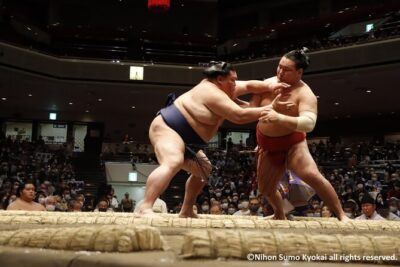
Tokyo Grand Sumo Tournament Viewing Tour with Tickets
Read our review →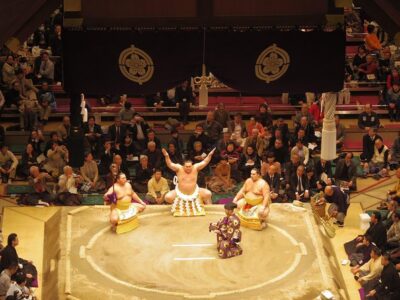
Tokyo:Luxury Sumo Show Experience & Japanese cuisine & Drink
Read our review →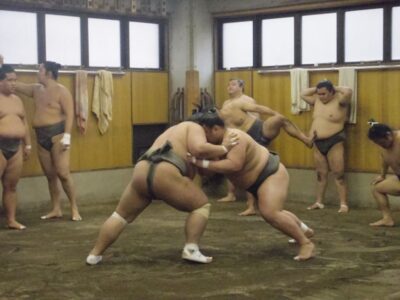
Ultimate Sumo Tournament: Tokyo, Osaka, Nagoya, Fukuoka
Read our review →This one also appears in