
Review · TOKYO
Ultimate Sumo Tournament: Tokyo, Osaka, Nagoya, Fukuoka
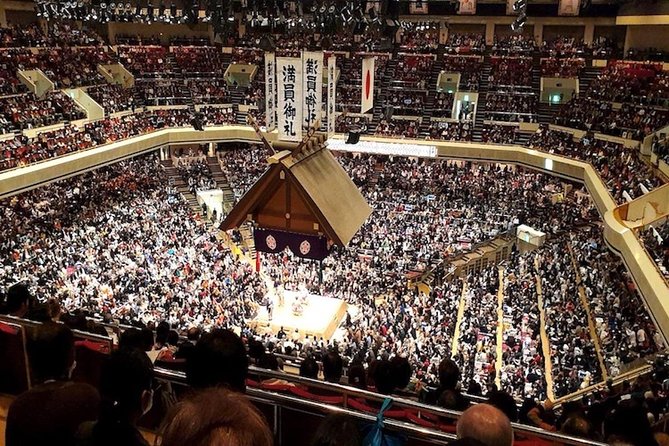
The real value here is not simply getting inside a sumo arena. It is having someone explain why wrestlers throw salt, how the rankings work, and what happens in the ring before the match lasts only a few seconds. The headset commentary helps you follow the action even in a noisy hall.
I like the reserved seating, which removes the stress of trying to buy scarce tickets yourself. I also like the chance to finish with chanko hot pot, the hearty stew associated with sumo stables. The main drawback is that standard seats are on the second floor, and the experience is non-refundable once booked.
Key points
- Official six-tournament schedule: Tokyo hosts the January, May, and September basho, while Osaka, Nagoya, and Fukuoka host the other three.
- Four hours at the arena: Expect guided explanations, time to watch bouts, and opportunities to buy food and drinks inside.
- Reserved seating: Standard tours use second-floor B or C seats, while private tours offer S or A seats closer to the ring.
- Audio headsets included: You can hear commentary over the crowd and arena noise.
- Optional chanko dinner: Add a sumo-style hot pot meal, with a vegetarian request available in advance.
- Off-season alternative: Watch morning practice at a stable near Warabi Station, but this option does not include a tournament ticket.
Why a Sumo Guide Changes the Afternoon
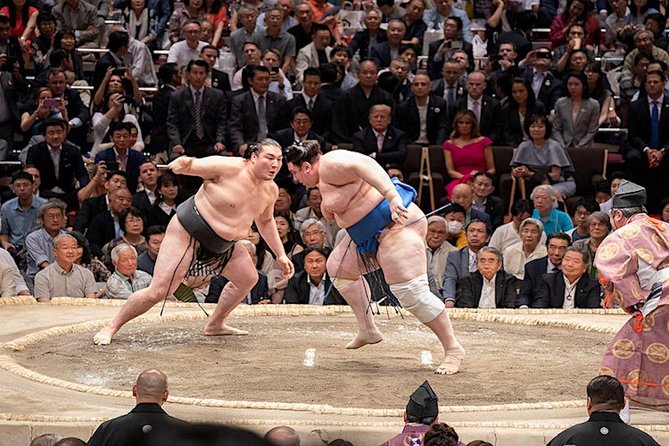
Sumo looks simple at first: two wrestlers, one ring, one winner. In practice, the sport is wrapped in ceremony, rankings, gestures, clothing, stable traditions, and rules that are easy to miss if you arrive without context.
This tour places an English-speaking local sumo expert beside you for about four hours. Guides such as Hiro, Myoko, Taku, Izumi, Yumi, Junka, and Shunsuke have led different departures, so the exact guide varies. The strongest guides explain the wrestlers’ rankings, match styles, ritual movements, and the cultural meaning behind what you see.
You receive a pamphlet and a banzuke, the official ranking table. Keep the banzuke open during the matches. It gives you a useful framework for understanding who is competing and where each wrestler sits in the sumo hierarchy.
The guide does not need to speak continuously. That is a good thing. You have time to watch, take in the arena, buy refreshments, and use the facilities. Before important bouts, the guide adds context through the headset. This balance works better than a nonstop lecture.
One caution: the quality of the explanation depends on how actively your guide works with the group. Most of the supplied feedback praises clear, passionate commentary, but one departure provided only limited explanation. If learning the rules is your main reason for booking, tell your guide early that you want more detail.
More Sumo Experiences in Tokyo
- Tokyo: Sumo Show and Dining Experience
★ 4.8 · 2,742 reviews - the SUMO show
★ 5.0 · 1,960 reviews - Tokyo Shinjuku Sumo Show & Experience with Photo
★ 5.0 · 1,750 reviews
Tokyo at Ryogoku Kokugikan
Tokyo’s official sumo venue is Ryogoku Kokugikan, in the district most closely linked with sumo. The experience begins at a meeting point sent to you by email at least one week before the date. The stated start time is 2 p.m., and the guided arena visit lasts about four hours.
At the venue, your guide helps you get oriented before you settle in. The group may pass through the Sumo Museum, though congestion can make a full group visit difficult. In that case, the guide may ask you to look around on your own.
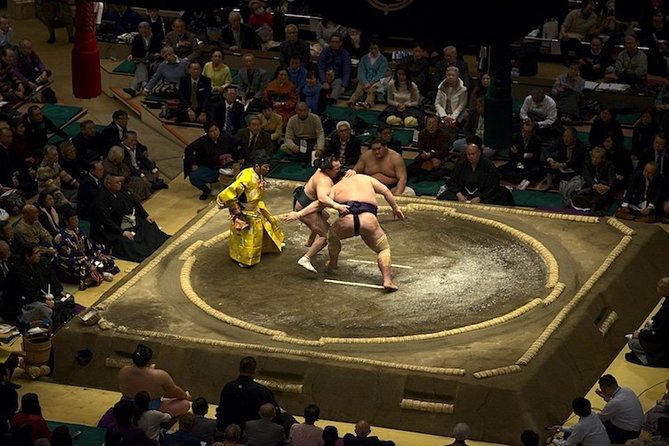
The standard group option uses B-class or C-class chair seats on the second floor. B seats are generally in rows 7 through 11, and the group can include up to 20 people sitting in the same area. These are not ringside seats, but they give you a broad view of the dohyo and the surrounding ceremonies.
The private option includes S-class or A-class seating, closer to the ring. You pay more for that position, but it can be worthwhile if you care about seeing the wrestlers at close range or want a more personal outing.
The Tokyo hall can feel warm, so dress in light layers. No outside food or drinks are allowed inside, but vendors sell refreshments and food in the arena. One useful small pleasure is the soft-serve ice cream available on the second floor.
Osaka, Nagoya, and Fukuoka Dates
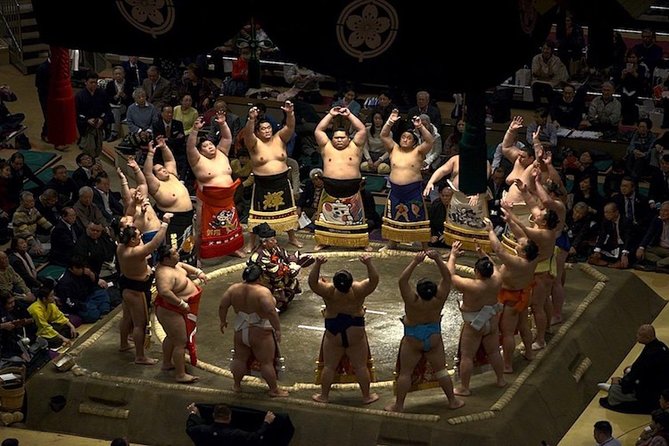
The tour follows Japan’s official annual schedule, so your choice of city depends on the month of your trip.
Osaka hosts the March tournament at EDION Arena Osaka. Nagoya hosts the July tournament at IG Arena. Fukuoka hosts the November tournament at Fukuoka Kokusai Center. Each basho runs for 15 days, beginning and ending on a Sunday.
Tokyo hosts three tournaments: January, May, and September. This schedule gives you six possible tournament periods each year, but there is no official basho in every city every month.
The Osaka, Nagoya, and Fukuoka versions are also described as four-hour guided visits. The ticket arrangement and exact seating depend on the selected tour type and the season. Read the final booking details carefully, since the meeting point and venue information arrive separately by email.
These regional tournaments can fit nicely into a wider trip. Osaka’s March event works well for a Kansai itinerary, while Nagoya in July and Fukuoka in November offer a reason to include those cities in a Japan route. The experience itself remains centered on the arena, not on transportation between cities, so you must make your own way to the meeting point.
What You Actually Watch in the Ring
The upper divisions provide the most recognizable names and the biggest crowd reaction. One useful feature of the afternoon is that you can see all of the top-division Makuuchi bouts, along with roughly half of the second-division Juryo bouts.
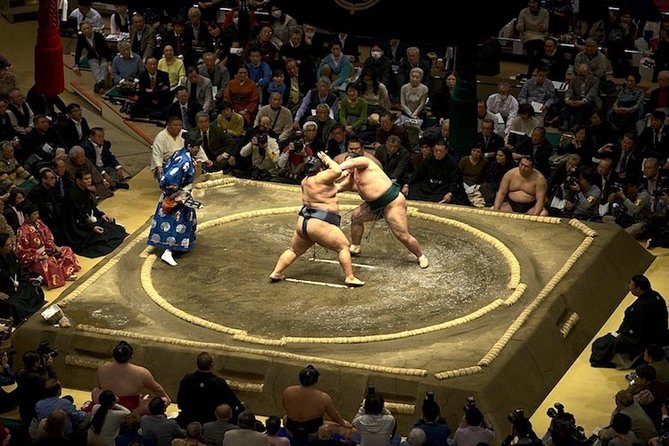
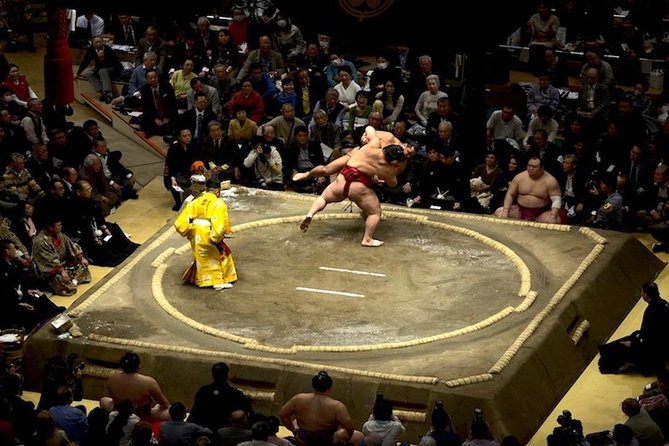
Sumo matches can be very short. That makes the lead-up important. The salt throwing, foot stamping, staring, crouching, and repeated preparation are not filler. They are part of the formal rhythm of the sport.
A guide can point out how the wrestlers approach a bout and explain basic techniques as they happen. You may learn why a wrestler wins by forcing an opponent out, or how a push, belt grip, or throw changes the contest. Since the action moves quickly, live commentary is particularly useful for first-time viewers.
The headset is a practical feature, not decoration. The arena is noisy, and ordinary conversation becomes difficult once the crowd reacts. At least one departure found the headset volume very loud even at its lowest setting, so bring earplugs or volume-reducing earbuds if your ears are sensitive.
You should still expect stretches of independent watching. The guide may offer commentary before and during selected matches rather than narrating every second. That gives you room to enjoy the event in your own way, but it also means this is not a formal classroom lesson.
Same city, another way to catch the action:
- Tokyo: Sumo Show and Experience in Shinjuku
★ 4.8 · 1,001 reviews - Tokyo Grand Sumo Tournament Viewing Tour with Tickets
★ 5.0 · 692 reviews - Tokyo Sumo Wrestling Tournament Experience
★ 5.0 · 660 reviews - Tokyo:Luxury Sumo Show Experience & Japanese cuisine & Drink
★ 4.7 · 577 reviews
Standard Seats, Private Seats, and Group Size
The standard join-in tour offers B-class or C-class second-floor chair seats. Up to 20 people may sit together with the English-speaking guide. This is the better-value choice if your priority is simply entering the tournament and understanding what you are seeing.
Second-floor seating also gives you a useful overall view. You will not have the close-up feeling of sitting near the ring, but you can follow the movement of the wrestlers and see the ceremony around the match.
Private tours use S-class or A-class seats closer to the dohyo. The upgrade makes the most sense for a special occasion, a serious sumo fan, or someone who dislikes being part of a larger group.
The price listed is $184.38 per person, with group discounts available. For that amount, you are paying not only for the seat but also for ticket arrangement, seating allocation, the guide, the pamphlet, the banzuke, and the headset. Since official tickets can sell out very quickly, the ticket-arrangement service is an important part of the value.
That price does not include hotel pickup, local transportation, meals, or drinks. You should budget for getting to the venue yourself and for anything you buy inside. The optional dinner costs extra as well.
Chanko Dinner After the Matches
If you choose the dinner add-on, the meal is chanko nabe, a Japanese hot pot associated with sumo wrestlers. It usually contains chicken stock, vegetables, and other ingredients cooked together in a shared pot. The dish has practical roots: a large amount can be prepared at once for hungry wrestlers after training.
This dinner gives the afternoon a satisfying cultural finish. You are not only watching sumo from the seats; you are also tasting a food closely linked with the sport.
Drinks are not included. The default meal uses traditional chanko broth, which commonly contains pork or chicken. Vegetarian guests can request a substitute broth in the special requirements field at checkout. Make that request early, because changes cannot be made one week before the tour date once the restaurant has accepted the request.
Other dietary needs should also be stated in advance. Do not assume that a vegetarian meal will be arranged automatically.
The Off-Season Stable Visit Near Warabi
If your Japan trip does not overlap with one of the six official tournaments, the alternative is a morning practice visit at a sumo stable near Warabi Station, about 30 minutes from Tokyo Station.
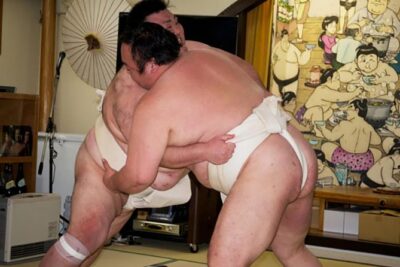
This option runs from 8 a.m. to noon and uses a join-in group of about 8 to 16 people. You watch wrestlers train at an authentic stable while a guide explains the practice through an audio headset. A chanko lunch follows the training session.
The stable visit offers a different kind of access. A tournament is public theater with thousands of people, formal scheduling, and a charged crowd. Morning practice is quieter and more focused on discipline, repetition, and preparation.
Be very clear about the difference before booking. The off-season choice does not include a tournament ticket. You visit the training stable only, with the guide and headset. If your main goal is to see live bouts in a full arena, wait for a tournament date instead.
The meeting point for the stable visit is near Warabi Station, and the exact directions are sent about one week before the date.
Planning Around Tickets and Timing
Book early. Three months before your travel date is the recommended target, with one month as the minimum suggested lead time. Group tickets are released by the Sumo Association roughly four to seven weeks before the tournament date.
If tickets cannot be obtained, you may be notified within four weeks of the tour and offered another date or a full refund. This is one reason not to build an entire itinerary around a single fixed tournament day until your reservation is confirmed.
Your meeting point is included in the final tour details sent by email. The operator does not provide hotel pickup or transportation, so leave enough time to reach the arena or station meeting point.
The non-refundable rule is strict. You cannot cancel or amend the experience for a refund after booking. Poor weather or failure to reach the minimum number of participants are exceptions, in which case another date or a full refund may be offered.
Who Will Enjoy This Most
I would choose this experience if you are curious about Japanese customs but do not yet know the sumo rules. The guide turns an unfamiliar event into something you can follow, and the headset helps you hear without standing next to the guide for the entire afternoon.
It also suits families and mixed-interest groups. Someone fascinated by rankings can focus on the banzuke, while another person can simply enjoy the ceremony and crowd. The four-hour length gives you a substantial visit without committing your entire day to a guided schedule.
Serious sumo fans may prefer the private seating option. If you mainly want the lowest-cost way to enter the arena, the standard group seats are more sensible.
This is less suitable if you want total flexibility. You must meet at a set time, sit with the assigned group, and accept a strict cancellation policy. It is also not a good choice for someone expecting a meal, hotel pickup, or a private ringside experience to be included automatically.
Should You Book It?
Book this tour if you want official tournament tickets plus clear help understanding what happens in front of you. The strongest value comes from the combination of scarce reserved seats, an informed English-speaking guide, audio equipment, and the chance to add chanko dinner.
Choose standard seating for the best balance of price and access. Pay for the private option only if a closer view or a more personal format matters to you. If your dates fall outside January, March, May, July, September, and November, consider the stable visit, but remember that it replaces the tournament rather than supplementing it.
For a first sumo experience, this is a sensible way into a sport that can otherwise feel confusing. Just confirm the city, date, seat category, dinner choice, and meeting point before you commit to the non-refundable booking.
FAQ
When do the official sumo tournaments take place?
The six annual tournaments take place in January in Tokyo, March in Osaka, May in Tokyo, July in Nagoya, September in Tokyo, and November in Fukuoka. Each tournament lasts 15 days.
What time does the tournament tour start?
The stated start time is 2 p.m. The guided arena experience lasts about four hours.
What seats are included in the standard tour?
Standard group tours use B-class or C-class chair seats on the second floor. B seats are generally in rows 7 through 11, and up to 20 people may sit together with the English-speaking guide.
Are closer seats available?
Yes. The private tour includes S-class or A-class seats closer to the ring.
Is food included?
Food and drinks are not included unless you select the optional dinner. Food and drinks can also be purchased from vendors inside the arena, but outside food and drinks are not allowed.
What happens if I visit during the off-season?
The off-season option is a morning practice visit at a sumo stable near Warabi Station. It runs from 8 a.m. to noon and includes a guide, headset, and chanko lunch, but it does not include a tournament seat ticket.
New on the fixture list around Tokyo
- Tokyo: Watching Sumo and Ryogoku Area Walking Tour★ 4.0 · 5 reviews
- Tokyo: Sumo Morning Practice Viewing Tour at a Real Stable★ 4.9 · 32 reviews
- Tokyo: Sumo Morning Practice -Stable Visit Tour with a Guide★ 4.8 · 16 reviews
- Tokyo: Sumo Morning Practice Tour in Ryogoku and Photo Shoot★ 4.7 · 47 reviews
- Tokyo: Sumo Keiko Training Tour with Audio Guide & Photo★ 4.8 · 5 reviews
- Tokyo Sumo Morning Practice: Witness the Life of a Wrestler★ 4.8 · 56 reviews
- Tokyo Highlights Tour: Sumo, Sushi, Tea, and Tokyo Tower★ 5.0 · 2 reviews
- Tokyo: Sanctuary Authentic Grand Sumo Experience & Training★ 5.0 · 7 reviews
More Sumo Experiences in Tokyo to weigh up.
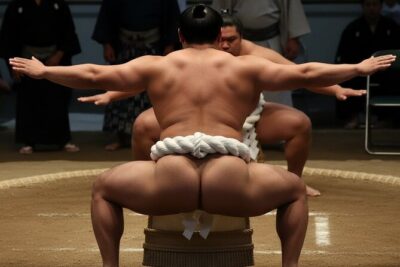
Tokyo Shinjuku Sumo Show & Experience with Photo
Read our review →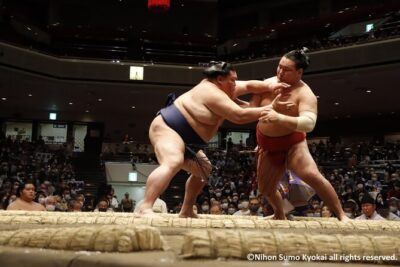
Tokyo Grand Sumo Tournament Viewing Tour with Tickets
Read our review →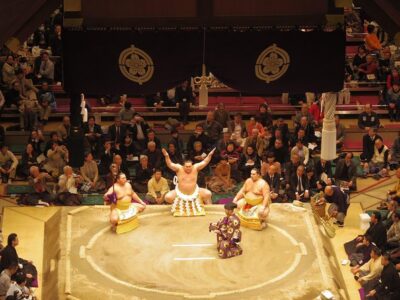
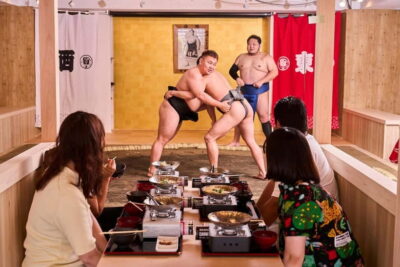
Tokyo:Luxury Sumo Show Experience & Japanese cuisine & Drink
Read our review →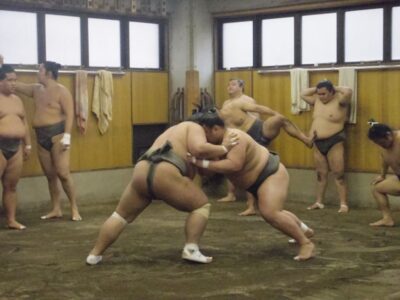
Tokyo Sumo Experience: Chanko & Mochi with a Former Pro
Read our review →This one also appears in