
Review · TOKYO
Watch Sumo Morning Practice at Stable in Tokyo
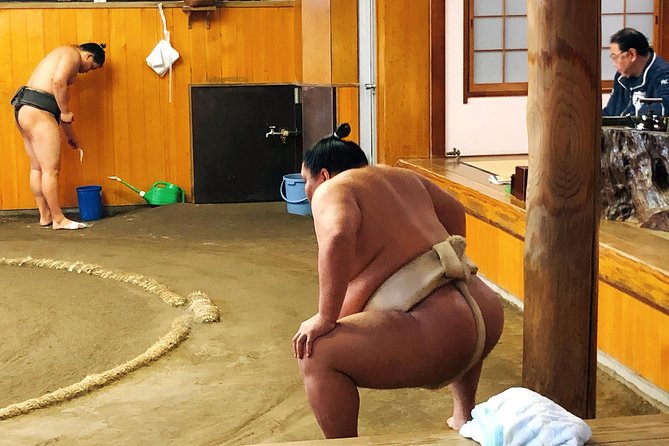
Sumo morning practice is not a staged show. You sit quietly beside the training ring as wrestlers stretch, stomp, grapple, and crash into one another with startling force. I like the close view of real training and the chance to see the discipline behind a sport most visitors know only from tournament broadcasts.
I also like that the experience takes you into a working stable, not a museum or a tourist theater. The quiet rules make sense, but they can be demanding: you may sit on the floor for up to two hours, and some departures offer little explanation once practice begins.
Key points before you book
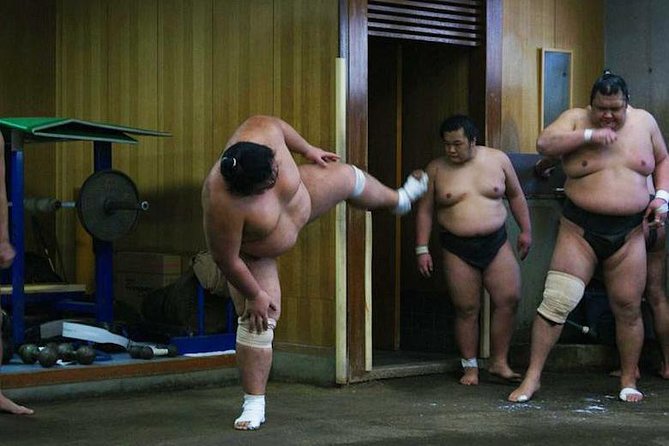
- Real morning training: Watch wrestlers move from stretching and warm-ups to drills and hard sparring.
- Quiet, respectful setting: You must not eat, talk loudly, or use bright flash photography or intrusive camera sounds.
- Floor seating matters: Expect to sit for a long time on a thin mat. A stool or chair may be available by request, but views can be poorer.
- Practice length changes: The session usually lasts 60 to 90 minutes, but Tokyo tournament periods can reduce it to 30 to 40 minutes.
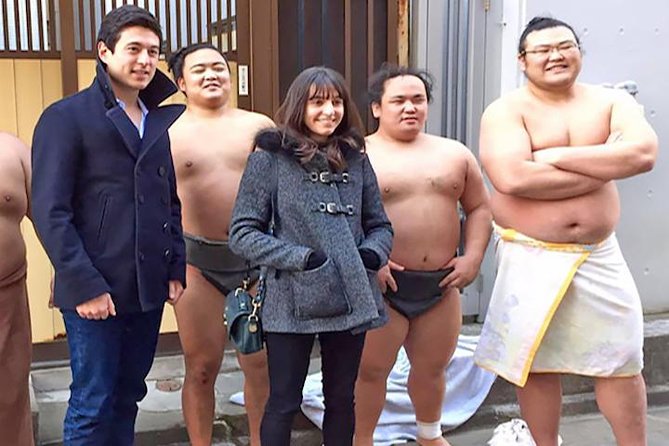
- Photos come at the end: A photo opportunity with wrestlers is included, though a late finish can sometimes affect this part.
- Small-group promise, variable seating: The activity lists a maximum of 10 people, yet the stable layout and seating position can still affect your view.
Seeing sumo before the public show
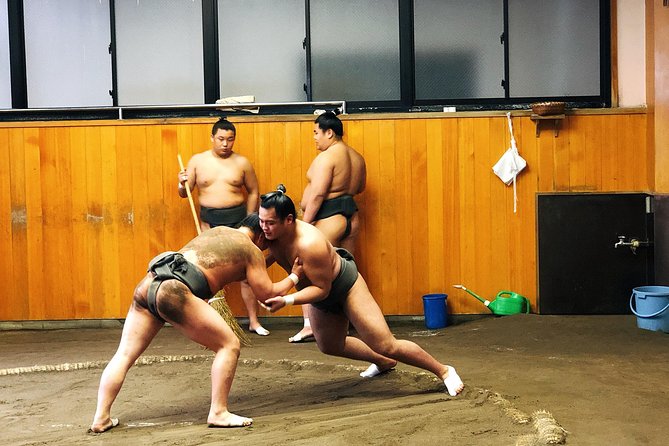
This experience gives you something a tournament cannot: the ordinary work behind the spectacle. There are no bright lights, announcers, or formal introductions as the wrestlers enter the ring. You watch athletes repeat movements, build strength, test one another, and listen to the stable’s rhythm.
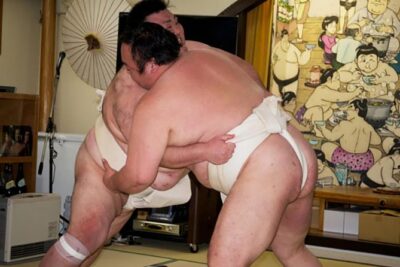
That quiet start is part of the appeal. Sumo practice can look simple at first, with long stretches of stretching, footwork, and repeated pushing exercises. Then the pace changes. The collisions become loud and physical, and the size of the wrestlers makes each impact feel more powerful than it does on television.
I like this because it shows sumo as a demanding sport rather than a costume display. You see the preparation, the concentration, the teasing between wrestlers, and the way more experienced men help or challenge younger ones. The practice has a team feeling, even though each bout is one wrestler against another.
The cost is about $95.77 per person. That is not a cheap way to spend an hour, especially since food and drinks are not included. But the price covers entry to a restricted working space and a rare chance to watch professional practice from close range. If sumo is high on your Tokyo list, the value is stronger than it is for someone simply looking for a quick cultural activity.
More Sumo Experiences in Tokyo
- Tokyo: Sumo Show and Dining Experience
★ 4.8 · 2,742 reviews - the SUMO show
★ 5.0 · 1,960 reviews - Tokyo Shinjuku Sumo Show & Experience with Photo
★ 5.0 · 1,750 reviews
Meeting in Tokyo and finding the stable
You make your own way to the meeting point in Tokyo, then join the guide and group before entering the stable. The listed itinerary identifies Ryogoku Kokugikan as the stop, but the exact stable conditions and location can depend on the wrestlers’ schedule. The final details may only be confirmed about a week before the visit.
That late confirmation is important. Sumo stables do not operate like museums with fixed public hours. Their practice schedule can change, and the stable may close during tournament periods. You should keep your morning flexible and avoid booking a tight connection, early train, or other activity immediately afterward.
The meeting arrangement is meant to prevent you from wandering around Tokyo searching for a private training building. Still, allow extra time. Some people have found the stable difficult to locate and have preferred taking a taxi from Asakusa. If you use a taxi, carry the address in Japanese because not every driver will be comfortable reading an English address.
Public transport and walking can work when the final location is clear, but this is not an activity I would approach casually on a rushed morning. Arrive early enough to check in, settle yourself, and get a better position before practice starts.
What happens inside the stable
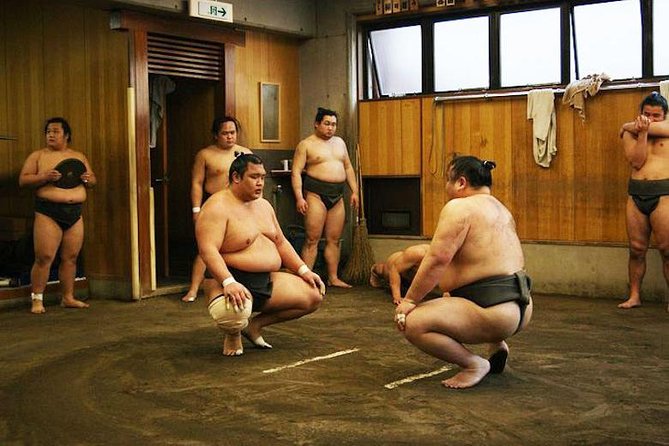
Once the group enters, you take a seat to the side of the dohyo, the raised sumo ring. The wrestlers continue their morning routine while you watch in silence. You might see stretching, warm-ups, footwork, pushing drills, and bouts that become more forceful as practice develops.
The stable is a workplace, not a theater. The wrestlers are not performing for the group, and their attention remains on training. That gives the visit its value, but it also sets the rules. Do not eat, talk loudly, distract the athletes, or use a flash. Avoid camera noises that could interrupt the session.
The best moments often come gradually. At first, you may wonder why so much time is spent repeating basic movements. Stay with it. The slow build helps you notice how the wrestlers prepare their bodies before the hard contact begins. You can also see how controlled the sport is, even when the collisions look brutal.
Some sessions include banter and advice between wrestlers. You may see younger men being corrected, challenged, or encouraged by those with more experience. That small human detail makes the practice easier to understand. It is not simply a parade of large athletes. It is a daily training system built on repetition, hierarchy, and respect.
The listed experience lasts about one hour, while the fuller description says roughly two hours. The practical expectation is a visit lasting between 60 and 90 minutes, with the overall meeting and photo time adding to your morning. Practice can run longer or finish earlier, so do not treat the advertised end time as exact.
The slow build from warm-up to sparring
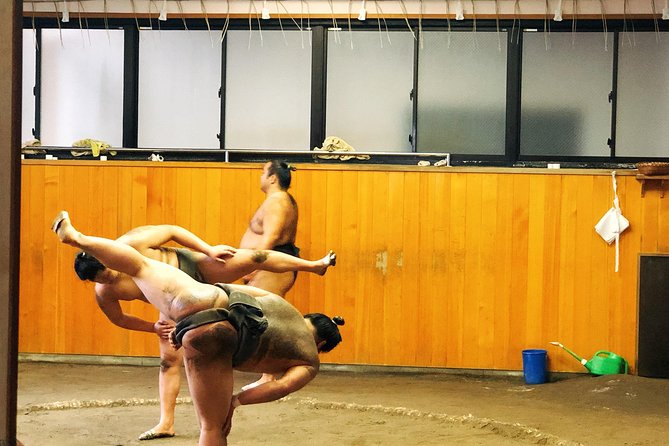
One of the most useful ways to judge this activity is to understand its pace. You are not watching two hours of constant wrestling. A substantial part may involve stretching, warm-up exercises, and repeated drills.
For someone interested in training methods, this is fascinating. You can watch the wrestlers prepare their balance, legs, hips, and pushing power. The repetition reveals how much work comes before a match. You also gain a better sense of why the athletes need such large, powerful bodies.
For someone expecting nonstop bouts, the same structure may feel slow. One person found 25 minutes of repeated exercise dull, while others were gripped by the full progression from warm-up to intense sparring. Your enjoyment depends on whether you can appreciate practice as practice.
I would suggest reading a little about sumo before you go. Learning the basic rules, the role of the dohyo, and the wrestler hierarchy will give the movements more meaning. Without that background, you may see stretching, pushing, and collisions without knowing what to watch for.
Some people also prepare by watching the documentary series Sanctuary. That is not required, but it can help you recognize the stable setting and understand the discipline involved. The activity itself may provide only limited explanation, so a little preparation makes a real difference.
Same city, another way to catch the action:
- Tokyo: Sumo Show and Experience in Shinjuku
★ 4.8 · 1,001 reviews - Tokyo Grand Sumo Tournament Viewing Tour with Tickets
★ 5.0 · 692 reviews - Tokyo Sumo Wrestling Tournament Experience
★ 5.0 · 660 reviews - Tokyo:Luxury Sumo Show Experience & Japanese cuisine & Drink
★ 4.7 · 577 reviews
Sitting on the floor is the main practical issue
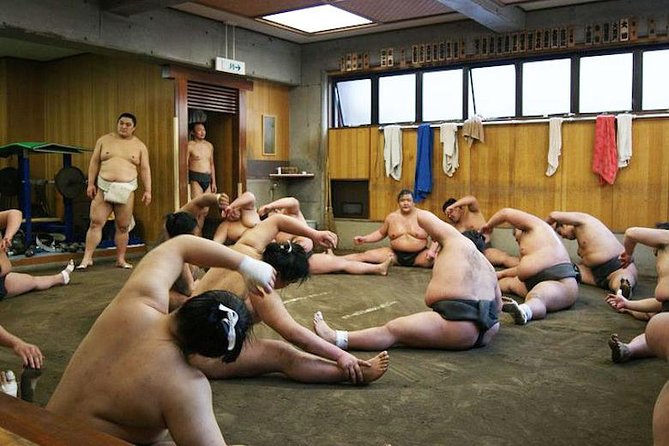
The biggest warning is physical, not cultural. You sit on the floor for a long period, often on a thin tatami mat over a hard surface. The position can become uncomfortable, especially if you have back, hip, knee, or leg problems.
A few chairs or stools may be available, and you can request one in advance. The tradeoff is important: a raised seat may offer a poorer view, depending on where it is placed. Do not assume that asking for a chair guarantees both comfort and a front-row position.
You also need to respect Japanese seating manners. Keep your feet from pointing toward the ring or other people. The room can be tight, so avoid constant shifting and keep personal belongings compact.
Arriving early helps with your position. Several accounts describe better views from the front and obstructed views from the back. In a small room, even one person sitting directly in front of you can block much of the dohyo. One particularly unlucky position behind the coach’s cushion left almost no view, which shows how much seating placement matters.
The official maximum is 10 people, but the physical room may still feel crowded depending on the stable and how seating is arranged. If seeing the action clearly is a priority, get there early and ask politely where the best available place is.
How much explanation will you get?
This is the most uneven part of the experience. Some departures include a guide who explains the history and rules of sumo and helps with transportation. A guide named Ricko was praised for arranging transport and explaining the visit, while Hiroko was noted for helping organize a small group.
You should not assume that level of guidance every time. At some sessions, the representative may mainly check names, open the door, and settle the group. You could receive little or no explanation during practice, and questions may need to wait until the end.
That is not necessarily a flaw if you already know what you are seeing. The stable’s quiet atmosphere would make a running commentary inappropriate. Still, if interpretation is important to you, confirm in advance what language support and guiding are included.
I would treat the experience first as an observation visit, not a guided lesson. The strongest part is being close to the wrestlers while they train. The educational side depends more on the guide, your preparation, and the questions you can ask before or after practice.
Photos, timing, and the end of the visit
After practice, there is time for photos with the wrestlers. This is a welcome finish because it gives you a personal reminder of the visit and lets you shift from silent observer to participant, briefly and respectfully.
Keep expectations modest. The photo session is not a long meet and greet. It can be quick, especially when several people are waiting. You should also remember that practice timing is outside the guide’s control.
A longer-than-expected session has caused some people to miss or shorten the photo opportunity. Since wrestlers follow their own training schedule, the advertised end time is approximate. If the photo matters greatly to you, do not book a nonrefundable lunch, train, or timed attraction immediately afterward.
The activity ends back at the meeting point. No food or drinks are provided, so plan breakfast separately. Because the start is early, eat before you enter the stable rather than expecting to snack during practice. Once inside, silence and attention are part of the etiquette.
Seasonal limits and the Tokyo tournament calendar
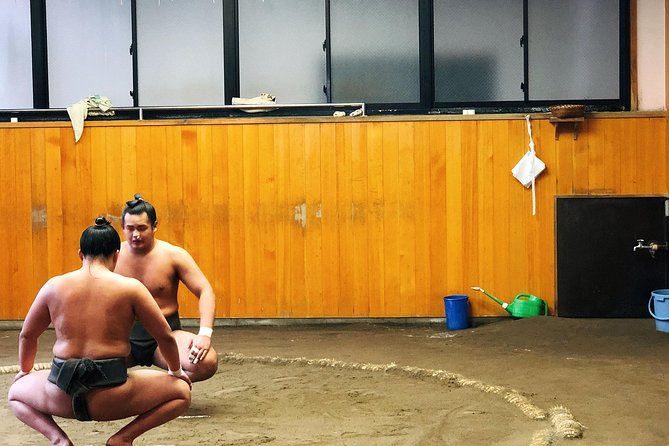
The calendar affects this visit more than many ordinary Tokyo activities. Practice conditions can be confirmed only about a week ahead, and the stable may be closed during tournaments held in other months.
Tokyo tournaments take place in January, May, and September, generally around the 15th to 25th. During those periods, practice may last only 30 to 40 minutes instead of the more typical 60 to 90 minutes. The price remains the same.
That does not make a tournament-period visit worthless. You can still see the wrestlers close up, and a shorter practice may suit you if you have limited patience or mobility. But you should not pay the same price expecting a full morning session.
The listed opening periods include Monday through Saturday from 8:00 to 10:00 a.m. during parts of February, March and April, and May 2026. Exact dates and stable access remain subject to the schedule, so confirm the final time after booking.
Who will enjoy this most?
I recommend this for people who want an authentic look at Japanese sport and ritual, not a polished performance. It suits you if you enjoy watching professionals repeat basic skills, notice small details, and sit quietly while something real unfolds.
Families can enjoy it too, provided children are at least 13 and can remain quiet. The power of the collisions makes an impression, and older children or teenagers may stay engaged through the warm-up and sparring.
It is a poor match for you if you need constant narration, dislike floor seating, or want an activity with a fixed ending. It is also not ideal if you have a packed Tokyo schedule and cannot tolerate a change in duration.
Most people can participate, but the floor requirement is serious. If you have mobility or back concerns, ask about a stool before booking and accept that the view may not be as good.
Booking, cancellation, and value
The experience costs $95.77 per person and is often reserved about 62 days ahead. That advance planning makes sense because stable availability is limited and the exact schedule may not be confirmed until close to the date.
Group discounts are available, and the ticket is mobile. Confirmation is sent within 48 hours when space is available. The minimum age is 13, and the activity has a maximum of 10 people according to the supplied booking conditions.
Cancellation terms are strict. Cancel at least six full days before the start for a full refund. Cancelling two to six days ahead gives a 50 percent refund, while cancelling less than two days ahead gives no refund. Changes inside three days are not accepted, and flight delays or illness are treated as cancellations. If poor weather causes the activity to be cancelled, you are offered another date or a full refund.
At this price, you are paying for access, not for a long guided tour or a meal. I think the value is good if sumo is a major interest and you want to see training at close range. It is less convincing if you are only mildly curious and would be satisfied with a tournament, museum display, or televised match.
Should you book this sumo morning practice?
Book it if you want to see the work behind sumo. The heavy breathing, repeated drills, ritual gestures, sudden impacts, and quiet concentration give you a more honest picture of the sport than a staged cultural show can provide.
Before booking, prepare for three things: limited explanation, uncertain timing, and hard floor seating. Learn a few basic sumo terms, arrive early, request a stool if needed, and leave your morning open.
I would choose this experience for a sumo fan, a repeat visitor to Tokyo, or anyone drawn to everyday traditions that are usually closed to outsiders. I would skip it if you need comfort, flexible timing, or nonstop action. For the right person, watching the wrestlers build slowly toward full sparring can be one of the most memorable hours in Tokyo.
FAQ
How long does the sumo practice visit last?
The practice usually lasts between 60 and 90 minutes. During Tokyo tournament periods in January, May, and September, it may last only 30 to 40 minutes. The ending time can vary each day.
Where does the activity take place?
The activity takes place at a sumo training stable in Tokyo. The itinerary identifies Ryogoku Kokugikan as the stop, while the exact stable conditions and location depend on the stable schedule.
Do I need to find the stable by myself?
You make your own way to the arranged Tokyo meeting point, where you meet the guide and group before entering the stable. The meeting arrangement is intended to help you avoid getting lost.
Is transportation included?
Transportation to and from the meeting point or stable is not listed as included. You must make your own way to the meeting point, and some people choose to use a taxi.
Do I sit on a chair or on the floor?
You should expect to sit on the floor for an extended period. A stool or chair may be available by request, but the view may not be as good.
Can I talk or take photos during practice?
You must remain quiet and avoid distracting the wrestlers. Eating, loud talking, bright flash photography, and intrusive camera sounds are not allowed during practice.
Are photos with the wrestlers included?
Yes. Photos with the wrestlers at the end are included, although the photo session can be affected if practice runs longer than expected.
Is food or drink included?
No. The activity does not include food or beverages.
What is the minimum age?
The minimum age is 13.
Can I cancel for a full refund?
You can receive a full refund if you cancel at least six full days before the experience start time. Cancelling two to six days ahead gives a 50 percent refund, and cancelling less than two days ahead is nonrefundable.
New on the fixture list around Tokyo
- Tokyo: Sumo Morning Practice Viewing Tour at a Real Stable★ 4.9 · 32 reviews
- Tokyo: Sumo Morning Practice -Stable Visit Tour with a Guide★ 4.8 · 16 reviews
- Tokyo: Watching Sumo and Ryogoku Area Walking Tour★ 4.0 · 5 reviews
- Tokyo Sumo Morning Practice: Witness the Life of a Wrestler★ 4.8 · 56 reviews
- Tokyo: Sumo Morning Practice Tour in Ryogoku and Photo Shoot★ 4.7 · 47 reviews
- Tokyo: Sumo Keiko Training Tour with Audio Guide & Photo★ 4.8 · 5 reviews
- Tokyo Highlights Tour: Sumo, Sushi, Tea, and Tokyo Tower★ 5.0 · 2 reviews
- Tokyo: Sanctuary Authentic Grand Sumo Experience & Training★ 5.0 · 7 reviews
More Sumo Experiences in Tokyo to weigh up.
Tokyo Shinjuku Sumo Show & Experience with Photo
Read our review →
Tokyo Grand Sumo Tournament Viewing Tour with Tickets
Read our review →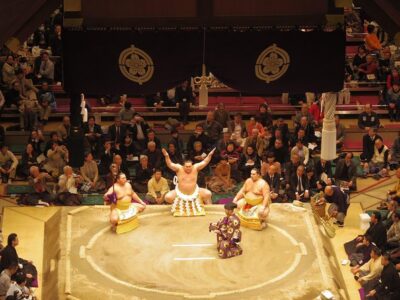
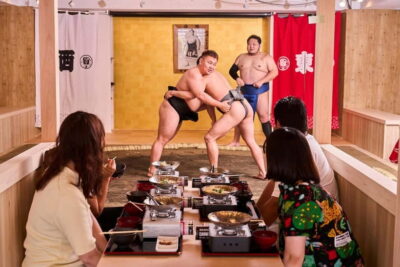
Tokyo:Luxury Sumo Show Experience & Japanese cuisine & Drink
Read our review →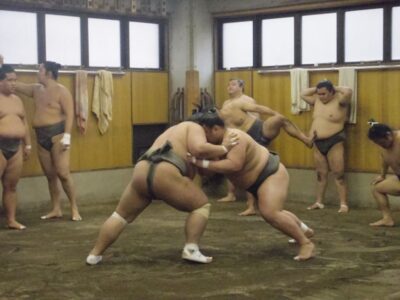
Tokyo Sumo Experience: Chanko & Mochi with a Former Pro
Read our review →This one also appears in