
Review · ROME
Tickets and Guided Tour of the Olympic Stadium in Rome and Foro Italico
Rome’s Olympic Stadium is more than a football ground. It is the center of a sports complex shaped by Mussolini-era politics, Italian national identity, tennis, athletics, and the fierce Roma-Lazio rivalry. This tour lets you walk in through the players’ entrance, visit the locker rooms, and get close to the pitch.
I like the mix of sport and politics, especially the stop at the Mussolini Obelisk and the explanation of Foro Italico. I also like the access to the pitch and changing rooms, which gives football fans the moments they came for. The main caution is that the tour can change at short notice when matches, concerts, or other events take over the stadium.
- Mussolini Obelisk: Begin with the political and architectural story of Foro Italico.
- Foro Italico complex: See more than the football stadium, including the wider sports setting and the Central Court of the Rome Masters.
- Players’ entrance: Follow the same route used before matches.
- Locker rooms and pitch: Get the close-up stadium access that casual visitors cannot count on.
- Roma and Lazio rivalry: Hear how the two Roman clubs share one stadium and a very divided local identity.
- Languages and access: Tours run in English, Italian, French, and Spanish, and the site is wheelchair accessible.
Why the Olympic Stadium tour is different
Many stadium tours focus on trophies, famous shirts, and club displays. This one takes a broader view. You are visiting the home ground used by both AS Roma and Lazio, but you are also walking through Foro Italico, a large sporting district with a strong political past.
That wider setting gives the tour more substance. Before you reach the turnstiles, your guide explains the Mussolini Obelisk and the design of the complex. You get a sense of how sport was used to project national strength in Fascist Italy, and how the area later became part of modern Rome’s sporting life.
The football angle remains central. Your guide covers the rivalry between Roma and Lazio, two clubs with different identities and fiercely loyal supporters. The best guides, including Simone, Angelica, Camila, and Kwanza, have been praised for explaining both clubs rather than turning the tour into a one-sided sales pitch.
You do not need to support either team to enjoy the visit. The stadium itself, the changing areas, the pitch, and the architecture provide plenty to see. Still, if you follow Italian football, the tour has an extra spark.
Starting at the Mussolini Obelisk
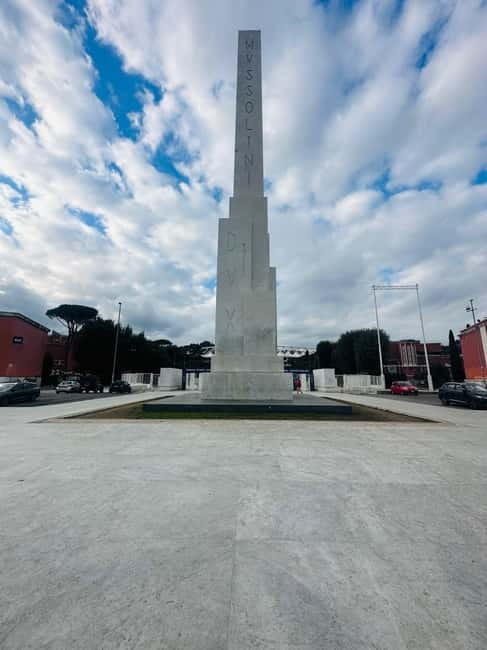
The meeting point is the Mussolini Obelisk, an enormous stone monument at the entrance to Foro Italico. It is hard to miss, but the area is large, so arrive with enough time to find the exact starting point.
This is not just a place to gather before walking inside. It is the first major lesson of the tour. Your guide explains the obelisk and the surrounding architecture, giving you the political background needed to understand why Foro Italico looks the way it does.
That context matters. Without it, the wide avenues, monumental buildings, statues, and formal planning can seem like a collection of grand sports facilities. With an explanation, the site becomes easier to read. You begin to see how the complex was designed to link sport with government, national pride, and public spectacle.
The quality of this opening section depends heavily on the guide. Strong guides use the area to tell a clear story before moving indoors. Kwanza, Simone, and Angelica received particularly warm praise for making the political and historical points easy to follow. If you are not a football fan, this part may be the reason the tour works for you.
More Olympic Venues in Rome:
- Olympic Stadium Tour with Expert Guide in Rome
★ 4.5 · 86 reviews - Berlin: Olympia Stadium Entrance Ticket
★ 4.3 · 789 reviews - The Olympic Museum Entrance Ticket in Lausanne
★ 4.5 · 211 reviews
Walking through Foro Italico
The Foro Italico portion lasts about 40 minutes. That is a useful amount of time because you are not rushed straight into the stadium. You walk through the wider complex and learn how the site functions as a sports center, not simply as a football venue.
The area has links to several sports. One tour group enjoyed seeing the Central Court of the Rome Masters, a reminder that tennis is part of Foro Italico’s identity too. The complex also hosts other sporting activity, and the tour may point out facilities or spaces that you would miss if you went directly to the stadium entrance.
This wider route is one of the tour’s strongest features. You get a better sense of the Olympic Stadium’s place within Rome instead of treating it as an isolated building. It also helps explain why the stadium can feel important even when no football match is taking place.
There is a small trade-off. The outdoor portion means you are exposed to the weather, and the amount of time spent in the wider sports complex may feel less exciting if you only want football access. One person specifically wished for more time in the Sport e Salute area, while another found the broader complex an added bonus.
Entering through the players’ route
The tour then moves into the Olympic Stadium for roughly 45 minutes. One of the most enjoyable moments is entering through the same general route used by players before a match.
This changes the mood immediately. Instead of arriving as a spectator through the normal public approach, you follow the path associated with pre-match preparation. Your guide describes the build-up to a game and points out the parts of the stadium connected with the teams and event staff.
You can expect plenty of time for photographs, although the precise access depends on what is happening at the stadium that day. The visit is designed to let you see the areas football fans care about most, rather than simply looking at the stadium from the stands.
The venue may be busy with preparations for a match, concert, or other event. During the summer concert season, the route can change. Parts of the stadium can also close or be altered without much notice. That is not necessarily a flaw in the tour operator’s planning, but you should book with some flexibility if seeing every listed area is essential.
Locker rooms, pitch access, and the stadium atmosphere
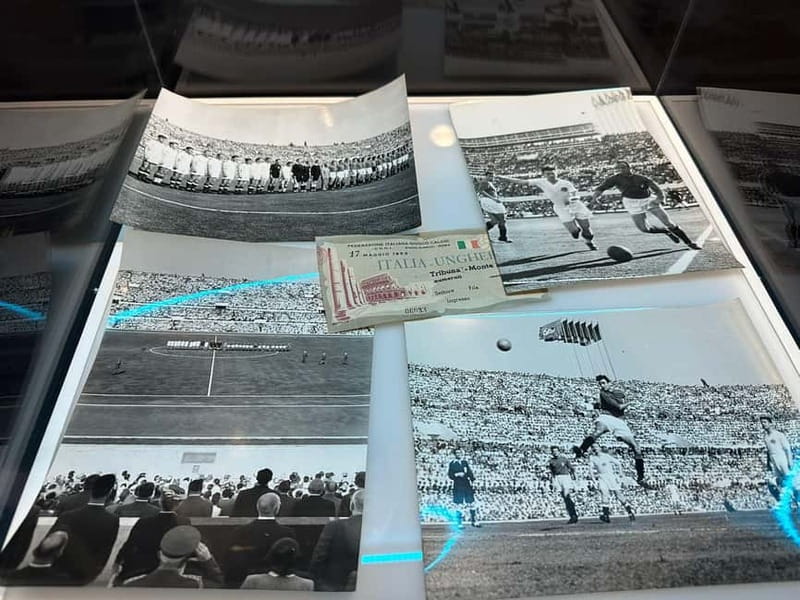
The locker rooms are a key stop. You see the place where players prepare, change, and focus before heading out. Your guide fills in the football side of the experience by discussing pre-match routines and the role the stadium plays for both Roma and Lazio.
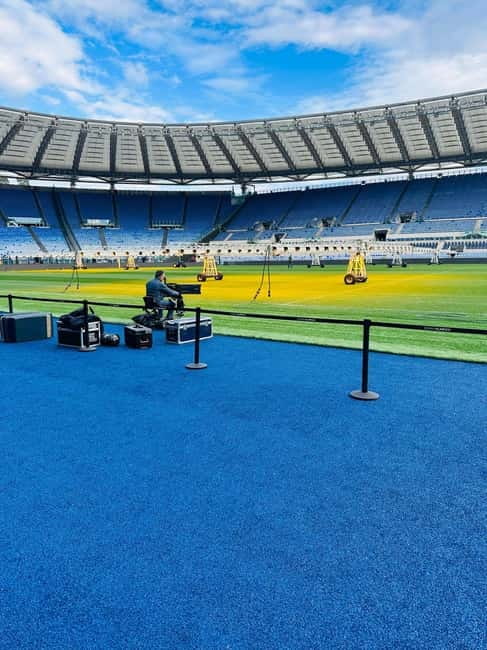
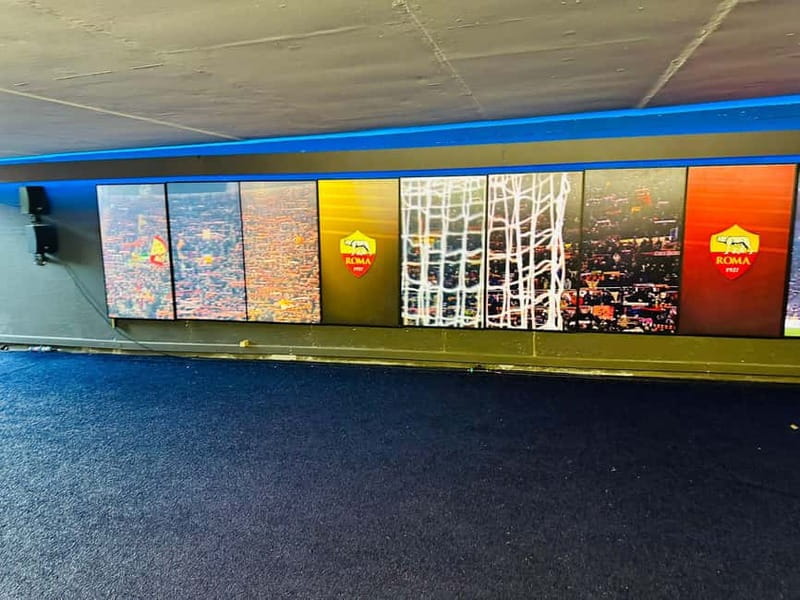
The pitch is the other big draw. Walking close to the field gives you a much stronger sense of the stadium’s scale than sitting in a regular seat. You can picture the players arriving through the tunnel, stepping onto the grass, and facing the noise from the stands.
This is also where the tour works well for families. One young visitor was especially excited to see the football pitch up close and even see herself on the stadium scoreboard. That kind of small, personal moment can make the visit memorable for children and teenagers.
Do not expect a full match-day atmosphere. The stadium will not be packed with supporters unless an event is taking place, and the tour is not a football game. Its value comes from access and explanation: you see behind the scenes, learn about the building, and connect the space to the teams that use it.
More sporting days out around Rome:
- Exclusive Golf Tour Private VIP with Local & Gelato o Wine
★ 5.0 · 500 reviews - Ticket to Piazza Navona Undergrounds Stadium of Domitian
★ 4.5 · 410 reviews - Piazza Navona Underground: Stadium of Domitian EXCLUSIVE TOUR – LIMITED ENTRANCE
★ 4.5 · 129 reviews - ROME: Golf-Cart Private Tour
★ 5.0 · 112 reviews
Roma, Lazio, and the story of two clubs
A good portion of the storytelling centers on Roma and Lazio. The clubs share the Olympic Stadium, but their rivalry is one of the defining features of Roman football culture.
Your guide explains the clubs’ backgrounds and the social meaning attached to them. The exact balance depends on who leads your group, but the best presentations cover both sides. Simone was praised for discussing the two clubs at length even though he personally supported Roma, while other guides made a point of keeping the information fair.
This section is most useful if you know little about Italian football. You do not need to memorize club history before arriving. The guide gives you enough background to understand why a shared home can also be a source of such fierce competition.
Fans of either club will probably get the most from these details, especially if the guide is comfortable answering questions. Football followers from outside Italy also have plenty of reasons to enjoy the visit. The tour connects a famous European stadium with the culture of the city around it.
The value of a $48 tour
At about $48 per person, this is not the cheapest way to see a sports venue. The price includes admission, a live guide, and skip-the-ticket-line entry. The total visit lasts about 90 minutes, with roughly 40 minutes in Foro Italico and 45 minutes inside the stadium, plus movement between sections.
I think the value is reasonable if you want guided access to the pitch and locker rooms. Buying access alone would not give you the political background, the story of the sports complex, or the explanation of the Roma-Lazio rivalry. You are paying for the interpretation as much as the building.
The value is less clear if you only want a quick look at the stadium. A weak or rushed guide can reduce the experience to a walk from one room to another. One person found the guide late and too limited in historical explanation, while another felt the group was hurried through the route. Those comments are a reminder to keep expectations realistic.
Most of the strongest guide feedback centers on clear explanations, warm personalities, and practical help. Angelica was praised for taking photos and checking that everyone was ready. Camila worked well for a mixed group that included someone with little interest in sport. Simon, Simone, Kwanza, Dayana, and Valentina were also singled out for friendly and capable guiding.
What happens after the stadium visit
The schedule includes free time at a local restaurant and a shopping stop at the stadium. The supplied details do not specify the restaurant, the length of the break, or the exact shop selection, so you should treat these as useful additions rather than the main reason to book.
The restaurant stop can give you a chance to pause after the walking sections. The stadium shopping portion may appeal to fans looking for team-related souvenirs, but the tour’s core value remains the guided access.
One group particularly enjoyed drinks in the Monte Mario Gold area at the end. That experience may not be identical on every departure, so do not book solely for a promised refreshment stop. Conditions inside the stadium can change according to the day’s events.
The listed finishing point is Viale dei Gladiatori 2. From there, you can continue exploring the Foro Italico area, subject to access and event restrictions.
Guides, languages, and group comfort
The tour is offered in Italian, English, French, and Spanish. You should select the language that lets you follow detailed explanations, since the experience depends on the guide’s storytelling rather than signs alone.
The strongest praise goes to guides who combine football facts with the wider story of Rome’s sports culture. Simone was repeatedly described as clear and engaging. Angelica received praise for her warmth, historical explanations, and help with photographs. Camila was a good fit for mixed-interest groups, including people who were not sports fans.
Audio equipment is worth considering. One person found it difficult to hear the guide clearly when the group was large and suggested microphones. If you have hearing concerns, ask about this when booking. Stay close to the guide and avoid drifting behind the group during outdoor explanations.
The tour is wheelchair accessible, but the operator asks you to state your accessibility needs when booking. Since the route can change, early notice is sensible.
Timing, changes, and practical expectations
The advertised duration is 1.5 hours, but the full outing may feel longer if the restaurant and shopping portions are included. Check the departure time carefully and allow room for the outdoor walk around Foro Italico.
The stadium can reschedule a visit, change the content, or close sections at short notice. Concert season is a particular pressure point, but matches and other events can also affect the route. If you are planning a tight connection afterward, leave extra time.
Free cancellation is available up to 24 hours before the tour for a full refund. You can also reserve and pay later, which helps if your Rome plans are still shifting.
Wear comfortable shoes. The tour combines outdoor walking with stadium corridors and standing stops. Bring a phone or camera, but keep your attention on the guide during the history sections. The best details are found before you reach the pitch.
Who should book this Olympic Stadium experience?
I would recommend it most strongly to football fans, families with children or teenagers, and anyone curious about Rome’s twentieth-century political architecture. It also works well for couples or groups with mixed interests because the tour is not limited to football trivia.
You should book it if you want to:
- See the pitch and locker rooms from close range.
- Understand why Roma and Lazio share such a famous and contested home.
- Learn how Foro Italico connects sport, architecture, and politics.
- Visit a major Rome venue with an English-speaking guide.
- Get a guided experience rather than wandering around without context.
I would think twice if your schedule cannot handle a possible route change, or if you need guaranteed access to every area. The stadium may close sections for reasons outside the operator’s control. Also, if you dislike group tours or want a long, slow architectural visit, 90 minutes may feel brisk.
Should you book it?
At $48, this is a fair buy for the right visitor. The pitch, locker rooms, and players’ entrance give football fans the access they want, while Foro Italico and the Mussolini Obelisk add a layer that most stadium visits miss.
Book it if you value a lively guide and want to understand the site, not just photograph it. If possible, choose a departure with enough time in your schedule and confirm the meeting point carefully. For football fans and curious Rome visitors, this is a useful look behind one of Italy’s best-known sporting venues.
FAQ
How long does the Olympic Stadium and Foro Italico tour last?
The advertised duration is 1.5 hours. About 40 minutes are planned for Foro Italico and about 45 minutes for the Olympic Stadium, with additional time connected to the restaurant and shopping portions.
What does the tour include?
The price includes entrance tickets, an expert live guide, and skip-the-ticket-line access. The route includes Foro Italico, the Olympic Stadium, the locker rooms, and the pitch, subject to changes caused by stadium events.
What languages are available?
Guided tours are available in Italian, English, French, and Spanish. Some content may be presented in its original language.
Is the tour wheelchair accessible?
Yes, the activity is listed as wheelchair accessible. You should inform the operator of your accessibility needs when booking because the stadium route can change.
Can the stadium route change?
Yes. The stadium may reschedule the tour, close parts of the venue, or change the content at short notice. Concerts, matches, and other events can affect access, especially during the summer concert season.
Where does the tour start and finish?
The tour starts at the Mussolini Obelisk in Foro Italico. It finishes at Viale dei Gladiatori 2.
Can I cancel the tour?
You can cancel up to 24 hours in advance for a full refund. The activity also offers a reserve-now, pay-later option.
New on the fixture list around Rome
- Rome: Full Experience Colosseum Arena Tour (MAX 10 PEOPLE)★ 5.0 · 8 reviews
- Rome: Navona Underground & Domitian Stadium Guided Tour★ 4.6 · 36 reviews
- Rome: Colosseum Arena Tour with Forum and Palatine Access★ 4.6 · 13 reviews
- Private golf-cart tour in Rome★ 5.0 · 2 reviews
- Rome: Stadium of Domitian Entry and City of Rome Audioguide★ 4.3 · 12 reviews
- Colosseum Arena Tour, Palatine Hill and Roman Forum★ 5.0 · 4 reviews
- Rome: Guided Group Tour of Colosseum, Palatine Hill & Roman Forum★ 5.0 · 65 reviews
- Full day private guided tour of Rome by golf-cart & Colosseum and Roman Forum★ 5.0 · 65 reviews
More Olympic Venues to weigh up.

Barcelona: Olympic and Sport Museum – Sports Experience
Read our review →
Maihaugen Museum/The Norwegian Olympic Museum, Lillehammer.
Read our review →
Athens Olympic Museum: Skip-the-Line Entry Ticket
Read our review →
Olympic and Sport Museum of Barcelona “Joan Antoni Samaranch”
Read our review →This one also appears in